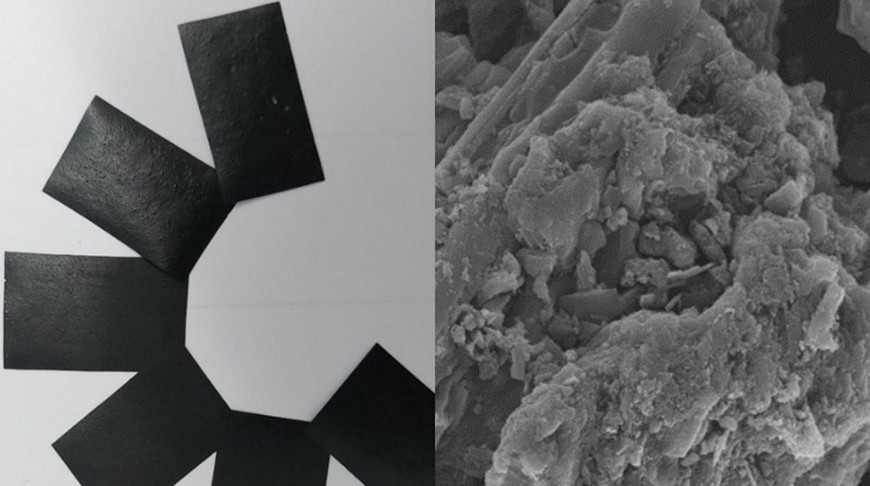
A project of the Belarusian State University has won a grant from the Innovation Foundation of the University Research Cooperation Network (iUNRC, China) for a new technology for producing activated carbon from wood waste. This was reported to BelTA by the BSU press service.
In their research, the BSU scientists used cheap Belarusian raw materials - wood waste and hydrolyzed lignin. "This method makes it possible not to cut down Belarusian or Russian birch trees to produce coal, which reduces production costs. In terms of its performance, such coal is significantly superior to the best global analogues and is able to fully ensure import substitution. As a result of production, in addition to coal itself, all-season phosphorus-potassium fertilizers are formed, which can be used in agricultural enterprises and even sold at retail to individuals. And if you mix these fertilizers with another component, they will not only increase fertility, but also improve the soil structure, which will lead to an increase in crop yields," the press service said.
In addition, domestic coal can be used to purify gas emissions and wastewater at industrial plants, and to remove radionuclides at nuclear power plants. Coal will also be able to be used in the production of drinking water, in the distillery industry for the purification of alcohol-containing products, in medicine and veterinary medicine as an enterosorbent.
"The terms of the grant assume three years of work on the project. At the moment, BSU scientists are improving the developed technology in order to maximize the properties of activated carbon. Special attention is being paid to the search for convenient dosage forms for the rapid introduction of charcoal into the human body," the university informed.
The scientific project is a joint development of the Scientific Research Institute of Physico-Chemical Problems and the Chemical Faculty of BSU. The ultimate goal is to launch the technology into industrial production.
The iUNRC Innovation Fund aims to provide financial support and comprehensive assistance to the implementation of scientific research at universities that are members of the University Network for Research Cooperation. This network was founded in 2023 as part of the First International Congress on Scientific and Technical Exchanges "One Belt, One Road" in Chongqing. It was initiated by the Ministry of Science and Technology of the People's Republic of China, the Chinese Academy of Sciences, the Chinese Academy of Engineering, the Chinese Association of Science and Technology, Sichuan Province and the Municipality of Chongqing. BSU also became one of the founders of the new association. In total, the network includes 151 universities from 38 countries. Such cooperation facilitates the international exchange of advanced information and resources, and the improvement of learning in the era of artificial intelligence.